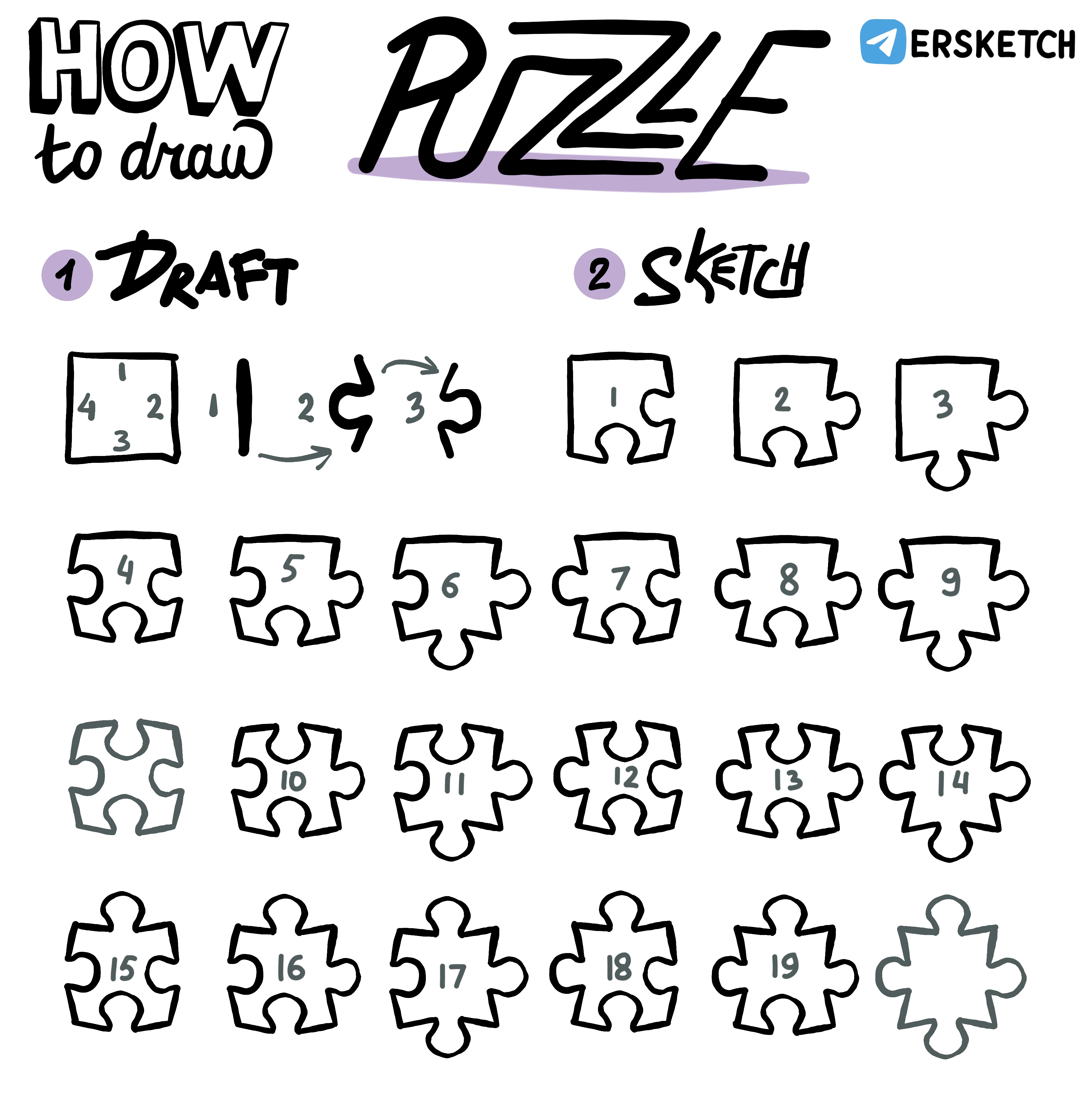
A puzzle piece has four sides. Each of them can be either flat, convex, or concave.
There cannot be more than two flat sides, so we'll discard those right away.
Pieces with two flat sides can be of three types: convex-convex, concave-convex, and concave-concave.
We'll replace one of the flat sides in turn with convex and concave. This gives us six more pieces.
Now for these six, we'll replace the last flat side with convex and concave. It seems pieces with all convex and all concave sides don't exist, so we'll remove those. This gives us ten.
In total, I got nineteen types of pieces. Hello Stephen King.
When you're drawing, note that the edges of a convex side are slightly concave, and those of a concave side are, conversely, slightly convex. This is needed so there's more room for holes inside the piece.