ErBlog
-
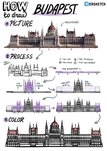
🏛️ Budapest
Today we'll be drawing Budapest, specifically the Hungarian Parliament Building, Országház. I really enjoy drawing buildings because by performing a large number of very simple actions, you can achieve an impressive result. You draw many sticks, circles, and triangles, and then look at what you've created and are amazed. The only drawback is that it takes a lot of time. I couldn't finish this picture in one sitting. So grab some coffee, turn on some music or an audiobook, and let's begin. First, we'll make a . This is necessary to see the main parts of the building. I've noticed that to truly see something, it's not enough to just look at it. When you try to draw it, you see twice as much. From the draft, we can understand what the building consists of, and we can start drawing the foundation. At this point, be careful not to overdo the vertical details. In general, all buildings have vertical and horizontal rhythms that divide the building into layers. The foundation will set the main vertical guidelines. Left, right, and central towers in the foreground, and what's between them in the background. The background lines in the foundation are positioned slightly lower. If we take the width of the central tower as 3, then the width of the outer ones will be about 2, and the connections about 4. Now let's draw the central tower. It will set the horizontal guidelines. Start from the bottom up, like a layered cake. A separate picture shows the layers it consists of. Each horizontal layer is divided into 9 vertical sections. At the intersection of layers are windows, arches, or turrets. Next are the wings. There are large arches that will set the vertical rhythm. There are 14-15 arches. The middle tower, which is 5 arches wide, starts 4 arches away from the central tower. A staircase 3 arches wide goes down from it. The side turrets are left. They consist of 5 repeating vertical patterns. The main thing is not to rush. Line by line, arch by arch, and it will all come together. -
Guest post for HowToDraw
Why shouldn't one of you draw the next picture for HowToDraw? So here's my offer: anyone who wants to can pick a topic for a drawing and write to me, and when that topic's turn comes up through the poll, I'll publish their picture and text, and draw my own as a participant! I've been wanting to add something fresh to our routine for a long time, and we'll get to know each other better along the way! Send your applications to sketch@erblack.me! -
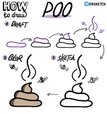
💩 Shit
Sometimes in a sketch you need to show something of very low quality. For this, good old shit is indispensable. Perhaps this time we'll use our imagination instead of a photo. To ensure the resulting product isn't mistaken for whipped cream, you can add smell and flies or color. -
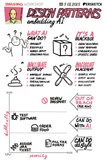
Embedding AI Into Existing Products
The last day of the Design Patterns For AI Interfaces workshop. About how to integrate AI into an existing project in a way that makes it better, not worse. -
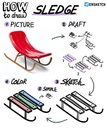
🛷 Sledge
January is coming to an end, and so are the winter themes for pictures. It's difficult to make sleds look like sleds from above or from the side. Let's try to create an isometric projection. First, we'll draw three small boards. If you want to add beauty, you can make them three-dimensional. Next, from the nearest board, we'll drop down two posts to attach the first runner. We'll add the tip of the second runner, fitting it along the line of the boards. You can also add fasteners and a small rope. -
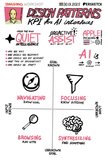
Design KPIs For AI Interfaces
The fourth day of the Design Patterns For AI Interfaces workshop. Even more patterns and classification of tasks by level of uncertainty. -
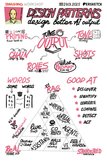
Designing Better AI Output
The third day of the Design Patterns For AI Interfaces workshop focused on how to improve LLM responses using magic words. But first, of course, they discussed DeepSeek 😀 -
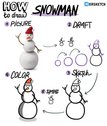
⛄ Snowman
Drawing a snowman is very easy. Three circles of different sizes from top to bottom. On the top one - a carrot nose, in the middle one - stick arms. -
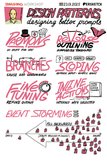
Designing Better Prompts For AI
Second day of the Design Patterns For AI Interfaces workshop. Prompt management patterns and, unexpectedly, Event Storming. -
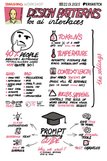
State of AI Interfaces
The first day of the workshop Design Patterns For AI Interfaces has passed. Here's what it covered: What do people think about how AI works, and how does it differ from how it actually works? What control knobs does AI have, and how do they affect the generation result? Why doesn't AI know how much text it will write, and how does it find out the weather? -
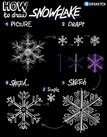
❄️ Snowflake
Water consists of oxygen and two hydrogens. When frozen, they turn into an isosceles triangle. If you stack these triangles like pizza slices, you get a snowflake. The shape of the snowflake depends on the freezing temperature. If it's not very cold, you get a flat snowflake, like the one on the right, and if it's very cold - a spiky one, like the one on the left. -
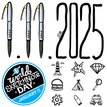
Today is World Sketchnote Day!
World Sketchnote Day is today! You can register and watch free workshops about sketches here: https://sketchnote.school/wsd/. Mine is here. -
🎩 Ushanka
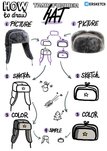
Today we'll be drawing a transformer hat. It's an ushanka. If you tie the ears on top, you can walk around looking brutally stern, like Schwarzenegger in "Red Heat," and if you lower the ears, it will be very warm. First, we draw the front fur part of the hat. It's rectangular with rounded edges. The next step depends on the style: For the warm version, you need to draw the side and top of the hat and the ears hanging down with ties. For the brutal version, draw the ears folded up and tied with a bow. -

World Sketchnote Day
Every year on January 11th, the World Sketchnote Day takes place. This is because 1.11 resembles three pens. In this case, various activities such as talks and workshops are held. This year, Sketchnote Day is special for me. I will be giving a talk about sketches at WSD by Sketchnote.School along with other cool sketchnoters. The event is free, you can register via the link https://sketchnote.school/wsd/. I invite everyone to join! -
🌕 Moon
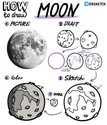
Moon. On one hand, the Moon is just a boulder flying in space, covered with craters. But on the other hand, the Moon is something much more. Firstly, the Moon always faces Earth with the same side. This means it has another side where almost anything could be. From a secret base of a infamous Austrian artist to Bowser's castle from Mario. In the middle of the last century, however, the far side was photographed, and some of the romance dissipated. Secondly, it glows at night. Have you ever tried walking on moonlit nights in places without light sources? You can see quite well there. And there are also such wonderful places on the Moon as the Sea of Tranquility and the Ocean of Storms. These names paint pictures in my head of a fantasy novel about a long journey across lunar seas. But we still need to draw a stone with craters. That's what we'll do. -
🔫 Bullet
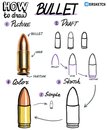
The bullet is what flies out of the pistol when fired, but we'll be drawing a cartridge. In addition to the bullet itself, the cartridge contains a case with a primer. The primer is a small cap containing a composition that ignites upon impact. The primer ignites the powder that fills the case. The burning powder propels the bullet through the barrel, and it flies towards the target. -
🔍 Magnifying glass
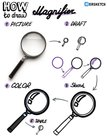
Magnifying glass is a standard metaphor for search or some kind of investigation. Drawing it is not difficult. A round lens and a rectangular handle. Highlights on the lens will make the image more recognizable. -
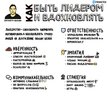
How to be a leader and inspire other people
#4 The final lecture of the course. Lots and lots of exercises for developing leadership skills. If you at least try to do all of them, you'll surely feel the changes. -
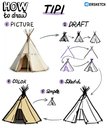
⛺ Tipi
A tipi is a type of Native American tent. It consists of straight poles arranged in a conical shape, with animal hides or canvas stretched around them. There's an opening at the top of the structure for smoke to escape, allowing for a fire to be built inside. To draw a tipi, start with two poles crossing at the top. Then carefully add the fabric wrapped around them, making sure the smoke hole is visible. Next, draw the lower part to make it look like poles wrapped in fabric. Finally, add a rope that holds everything together at the top. -
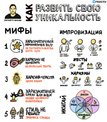
How to develop your uniqueness
#3 The third lecture of the course was mostly about myths about charisma. -
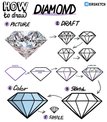
💎 Diamond
A diamond has a complex structure. Initially, I attempted to draw it as depicted in the image, but the result was chaotic. I realized I wouldn't be able to remember how to draw it accurately. Consequently, I had to simplify the process, and then simplify it even further. Here's the method I developed: Draw the basic shape of the diamond: a straight top surface, followed by two lines extending to the sides, from which two more lines connect at a single point at the bottom. Add a horizontal line at the junction of the sides. Draw two central edges that diverge slightly and symmetrically to the sides, converging at the bottom point. Finally, draw two side edges extending from the upper corners, also converging at the bottom point. These should be at a greater angle than the central edges. -
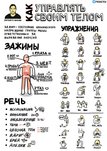
How to control your body
#2 The second lecture of the course was more than entirely made up of exercises for relaxing the body and the brain. -
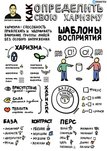
How to define your charisma
#1 Started another course. Charisma: how to attract and inspire others. Notes for the first lecture: How to define your charisma. An intriguing start, except I'm a week behind on the course :-) Need to catch up. -
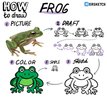
🐸 Frog
The frog has big eyes that stick up from its triangular snout. The front legs are small, while the hind legs are larger and stick out at the knees to the sides. Between the legs, you can see its belly. -
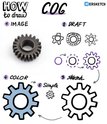
⚙️ Cog
The cog is needed to transmit rotation. One turns and rotates another with its teeth. The other will rotate in the opposite direction, and if they are of different sizes, at a different speed. A huge amount of things work thanks to the correct ratio of cogs, so the cog is an excellent standard metaphor for settings, mechanisms, and work in general. We start drawing the cog with a circle. Around the circle, we'll draw a larger circle with a dashed line. All that's left is to draw neat teeth over the gaps in the dashed line.